Publications
Research publications in quantum computing, quantum machine learning, and robust machine learning.
2026
- Carla Cotea, Stefan Balauca, and Andreea ArusoaiearXiv preprint arXiv:2610.10254, 2026
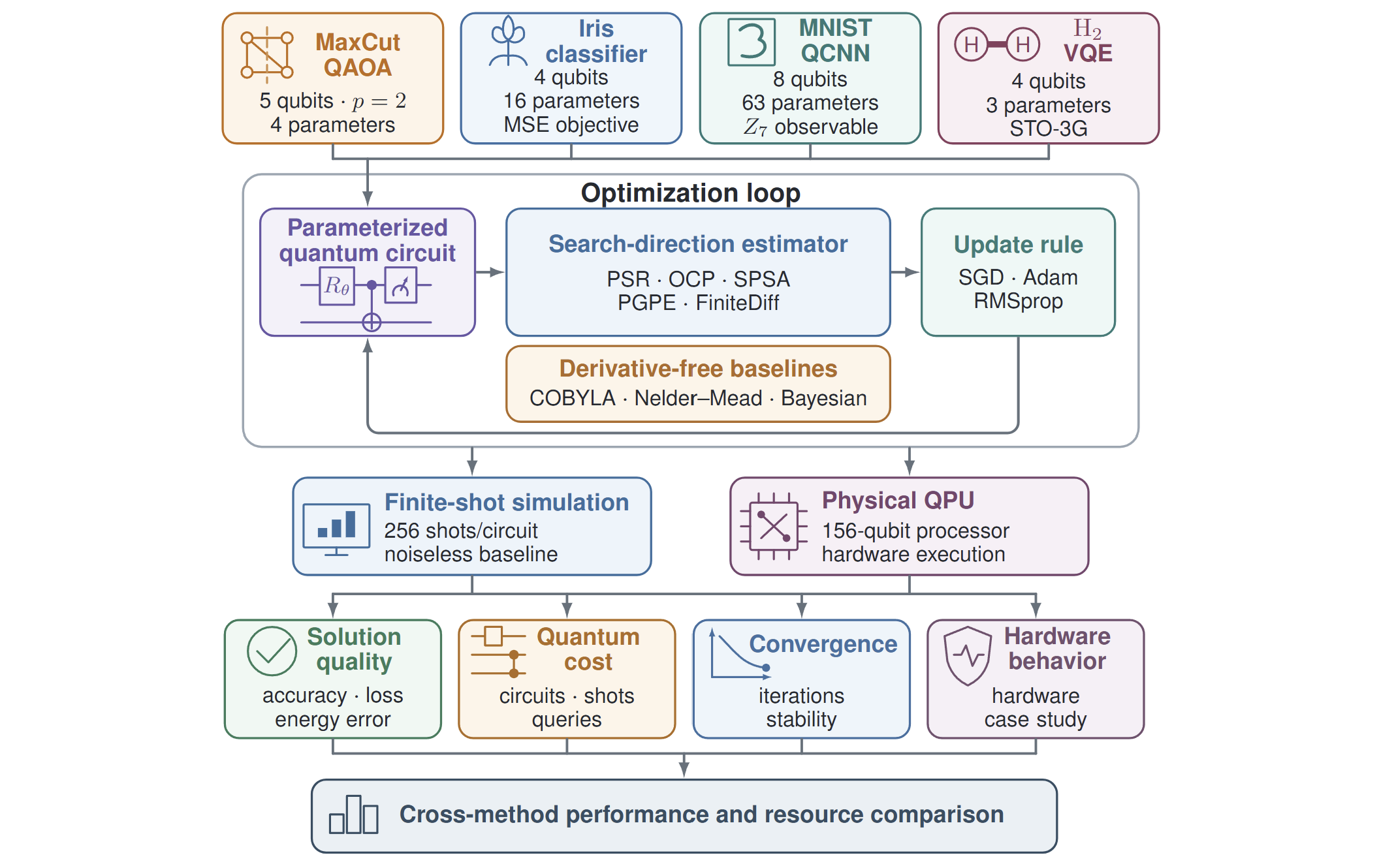
Training parameterized quantum circuits requires balancing optimization progress with limited evaluation budgets and the statistical uncertainty of near-term quantum hardware. We present a modular benchmarking framework that separates quantum search-direction estimation from classical parameter-update rules, allowing their interactions and sensitivities to be examined independently. We evaluate a suite of gradient-based, stochastic, and derivative-free optimizers across combinatorial optimization using the Quantum Approximate Optimization Algorithm (QAOA), supervised quantum machine learning using Iris classification and a quantum convolutional neural network (QCNN) for binary MNIST classification, and quantum chemistry using the variational quantum eigensolver (VQE) for molecular hydrogen. By separating objective evaluations from sample-circuit costs under finite-shot simulation and physical execution on a 156-qubit processor, we compare optimizer behavior across workloads with different parameter counts and measurement requirements. Four selected simulator and hardware case studies report terminal and best observed objectives separately, alongside post-training classifier accuracies. The comparisons include selected MaxCut and hydrogen trajectories and illustrate workload-dependent objective changes and evaluation costs, while the simulator benchmark compares both peak and mean performance across three seeds. The hardware runs do not establish an optimizer ranking or isolate a causal effect of device noise.
@misc{cotea2026benchmarking, title = {Benchmarking Modular Optimization Strategies for Parameterized Quantum Circuits}, author = {Cotea, Carla and Balauca, Stefan and Arusoaie, Andreea}, year = {2026}, eprint = {2610.10254}, archiveprefix = {arXiv}, primaryclass = {quant-ph}, url = {https://arxiv.org/abs/2610.10254}, } - A.-G. Panca, M. Ciorătanu, Stefan Balauca, and 1 more authorIn 30th International Conference on Knowledge-Based and Intelligent Information & Engineering Systems, 2026
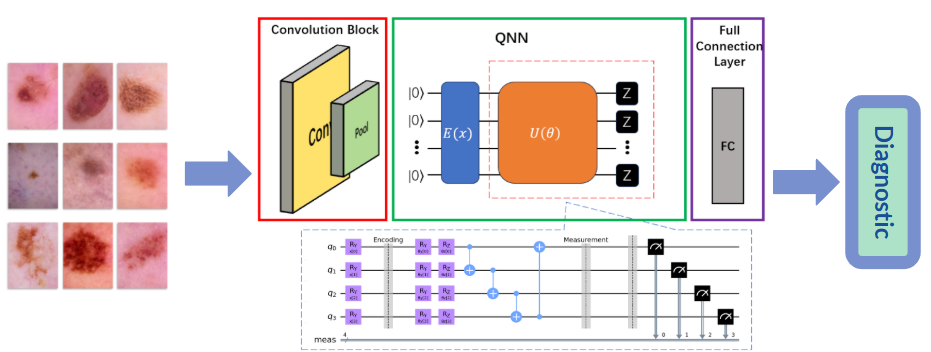
Automated analysis of dermoscopic images can support benign-versus-malignant skin lesion classification, but the practical usefulness of hybrid quantum-classical models remains unclear under current hardware constraints. This paper presents an experimental comparison between a classical MobileNetV2-based baseline and a hybrid pipeline that combines convolutional feature extraction with a variational quantum circuit for binary classification on the publicly available HAM10000 dataset. In the hybrid approach, image features extracted by the classical backbone are projected to a low-dimensional latent space and encoded into a trainable quantum circuit. Both models are evaluated on disjoint train, validation, and test splits, with model selection for the quantum pipeline performed on the validation set. The classical baseline clearly outperformed the hybrid model. The selected hybrid configuration reached a balanced accuracy of 0.582 and an area under the receiver operating characteristic curve (AUC) of 0.610 on the held-out test set. We also validated inference on IBM Quantum backends, confirming compatibility with execution on real quantum hardware. Taken together, these results suggest that the hybrid pipeline is better viewed as a feasibility study under current noisy intermediate-scale quantum (NISQ) limitations rather than as a replacement for strong classical image classifiers.
@inproceedings{panca2026skin,
  title = {Experimental Comparison of a Classical CNN and a Hybrid Quantum-Classical Model for Dermoscopic Skin Lesion Classification},
  author = {Panca, A.-G. and Ciorătanu, M. and Balauca, Stefan and Iftene, Adrian},
  year = {2026},
  booktitle = {30th International Conference on Knowledge-Based and Intelligent Information & Engineering Systems},
}

2025
- Stefan Balauca, Ada-Astrid Balauca, and Adrian IftenearXiv preprint arXiv:2512.12710, 2025
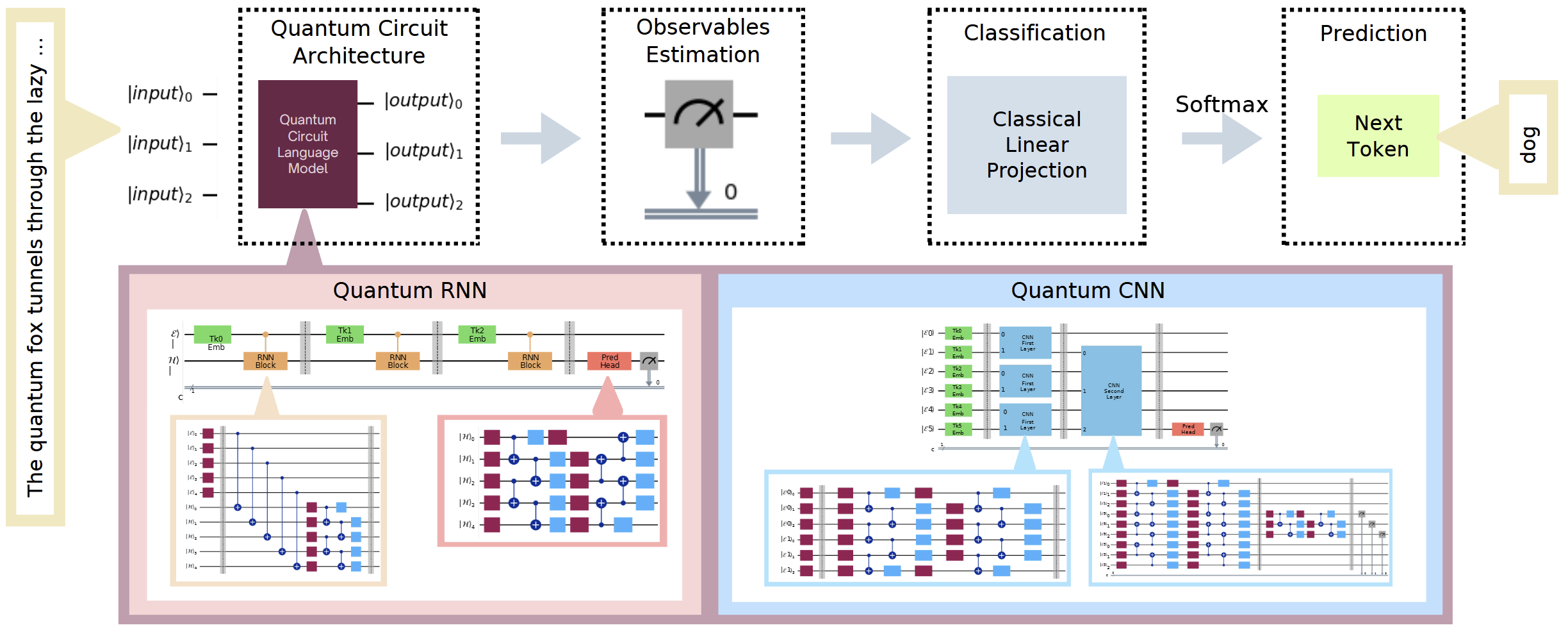
Hybrid quantum-classical models represent a crucial step toward leveraging near-term quantum devices for sequential data processing. We present Quantum Recurrent Neural Networks (QRNNs) and Quantum Convolutional Neural Networks (QCNNs) as hybrid quantum language models, reporting the first empirical demonstration of generative language modeling trained and evaluated end-to-end on real quantum hardware. Our architecture combines hardware-optimized parametric quantum circuits with a lightweight classical projection layer, utilizing a multi-sample SPSA strategy to efficiently train quantum parameters despite hardware noise. To characterize the capabilities of these models, we introduce a synthetic dataset designed to isolate syntactic dependencies in a controlled, low-resource environment. Experiments on IBM Quantum processors reveal the critical trade-offs between circuit depth and trainability, demonstrating that while noise remains a significant factor, observable-based readout enables the successful learning of sequential patterns on NISQ devices. These results establish a rigorous engineering baseline for generative quantum natural language processing, validating the feasibility of training complex sequence models on current quantum hardware.
@misc{balauca2025quantumlanguage, title = {Practical Hybrid Quantum Language Models with Observable Readout on Real Hardware}, author = {Balauca, Stefan and Balauca, Ada-Astrid and Iftene, Adrian}, year = {2025}, eprint = {2512.12710}, archiveprefix = {arXiv}, primaryclass = {quant-ph}, url = {https://arxiv.org/abs/2512.12710}, doi = {10.48550/arXiv.2512.12710}, } - Csaba Dékány, Stefan Balauca, Robin Staab, and 2 more authorsIn Advances in Neural Information Processing Systems, 2025
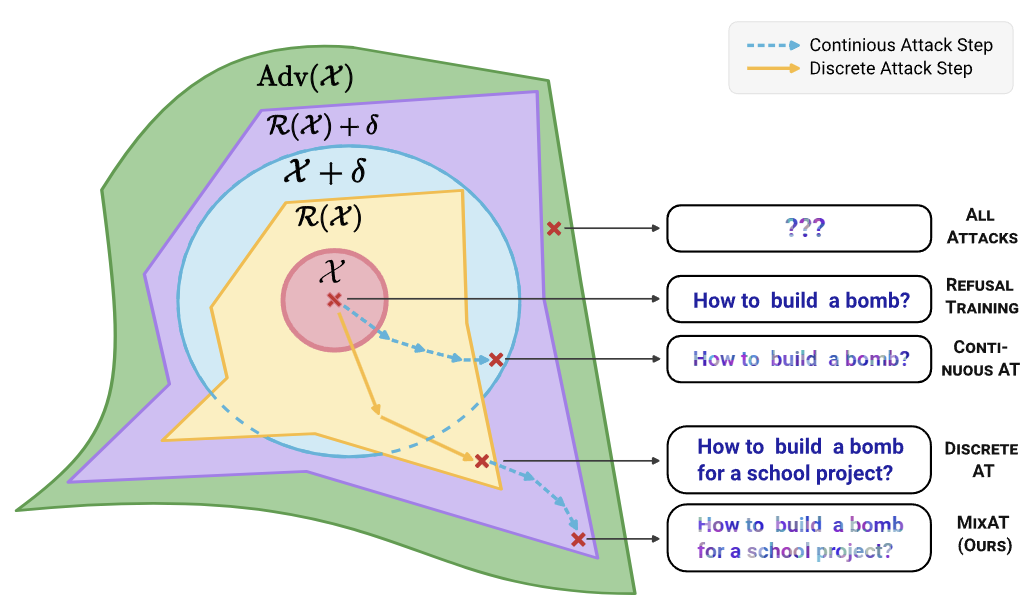
Despite recent efforts in Large Language Models (LLMs) safety and alignment, current adversarial attacks on frontier LLMs are still able to force harmful generations consistently. Although adversarial training has been widely studied and shown to significantly improve the robustness of traditional machine learning models, its strengths and weaknesses in the context of LLMs are less understood. Specifically, while existing discrete adversarial attacks are effective at producing harmful content, training LLMs with concrete adversarial prompts is often computationally expensive, leading to reliance on continuous relaxations. As these relaxations do not correspond to discrete input tokens, such latent training methods often leave models vulnerable to a diverse set of discrete attacks. In this work, we aim to bridge this gap by introducing MixAT, a novel method that combines stronger discrete and faster continuous attacks during training. We rigorously evaluate MixAT across a wide spectrum of state-of-the-art attacks, proposing the At Least One Attack Success Rate (ALO-ASR) metric to capture the worst-case vulnerability of models. We show MixAT achieves substantially better robustness (ALO-ASR < 20%) compared to prior defenses (ALO-ASR > 50%), while maintaining a runtime comparable to methods based on continuous relaxations. We further analyze MixAT in realistic deployment settings, exploring how chat templates, quantization, low-rank adapters, and temperature affect both adversarial training and evaluation, revealing additional blind spots in current methodologies. Our results demonstrate that MixAT’s discrete-continuous defense offers a principled and superior robustness-accuracy tradeoff with minimal computational overhead, highlighting its promise for building safer LLMs.
@inproceedings{dekany2025mixat, title = {MixAT: Combining Continuous and Discrete Adversarial Training for LLMs}, author = {Dékány, Csaba and Balauca, Stefan and Staab, Robin and Dimitrov, Dimitar I. and Vechev, Martin}, year = {2025}, booktitle = {Advances in Neural Information Processing Systems}, volume = {38}, url = {https://arxiv.org/abs/2505.16947}, } - Ada-Astrid Balauca, Sanjana Garai, Stefan Balauca, and 8 more authorsIn Proceedings of the IEEE/CVF International Conference on Computer Vision (ICCV), 2025
Museums serve as repositories of cultural heritage and historical artifacts from diverse epochs, civilizations, and regions, preserving well-documented collections that encapsulate vast knowledge, which, when systematically structured into large-scale datasets, can train specialized models. Visitors engage with exhibits through curiosity and questions, making expert domain-specific models essential for interactive query resolution and gaining historical insights. Understanding exhibits from images requires analyzing visual features and linking them to historical knowledge to derive meaningful correlations. We facilitate such reasoning by (a) collecting and curating a large-scale dataset of 65M images and 200M question-answer pairs for exhibits from all around the world; (b) training large vision-language models (VLMs) on the collected dataset; (c) benchmarking their ability on five visual question answering tasks, specifically designed to reflect real-world inquiries and challenges observed in museum settings. The complete dataset is labeled by museum experts, ensuring the quality and the practical significance of the labels. We train two VLMs from different categories: BLIP with vision-language aligned embeddings, but lacking the expressive power of large language models, and the LLaVA model, a powerful instruction-tuned LLM enriched with vision-language reasoning capabilities. Through extensive experiments, we find that while both model types effectively answer visually grounded questions, large vision-language models excel in queries requiring deeper historical context and reasoning. We further demonstrate the necessity of fine-tuning models on large-scale domain-specific datasets by showing that our fine-tuned models significantly outperform current SOTA VLMs in answering questions related to specific attributes, highlighting their limitations in handling complex, nuanced queries.
@inproceedings{balauca2025museum, title = {Understanding Museum Exhibits using Vision-Language Reasoning}, author = {Balauca, Ada-Astrid and Garai, Sanjana and Balauca, Stefan and Shetty, Rasesh Udayakumar and Agrawal, Naitik and Shah, Dhwanil Subhashbhai and Fu, Yuqian and Wang, Xi and Toutanova, Kristina and Paudel, Danda Pani and {Van Gool}, Luc}, year = {2025}, booktitle = {Proceedings of the IEEE/CVF International Conference on Computer Vision (ICCV)}, pages = {2227--2238}, url = {https://arxiv.org/abs/2412.01370}, doi = {10.1109/ICCV51701.2025.00215}, } - Yuhao Mao, Stefan Balauca, and Martin VechevIn Proceedings of the 42nd International Conference on Machine Learning, 2025
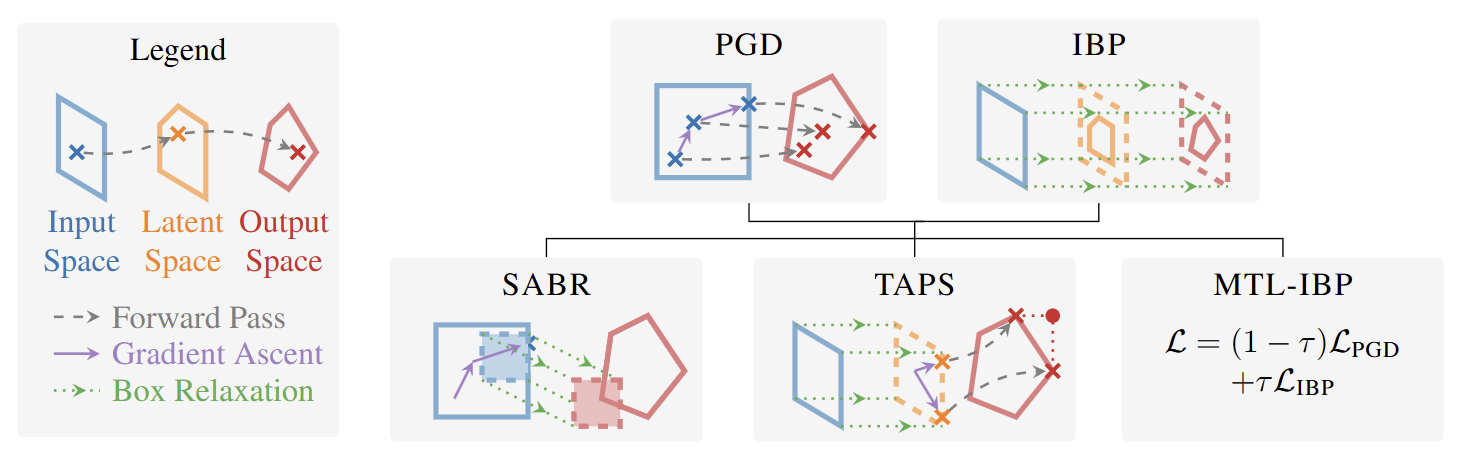
Training certifiably robust neural networks is an important but challenging task. While many algorithms for (deterministic) certified training have been proposed, they are often evaluated on different training schedules, certification methods, and systematically under-tuned hyperparameters, making it difficult to compare their performance. To address this challenge, we introduce CTBench, a unified library and a high-quality benchmark for certified training that evaluates all algorithms under fair settings and systematically tuned hyperparameters. We show that (1) almost all algorithms in CTBench surpass the corresponding reported performance in literature in the magnitude of algorithmic improvements, thus establishing new state-of-the-art, and (2) the claimed advantage of recent algorithms drops significantly when we enhance the outdated baselines with a fair training schedule, a fair certification method and well-tuned hyperparameters. Based on CTBench, we provide new insights into the current state of certified training, including (1) certified models have less fragmented loss surface, (2) certified models share many mistakes, (3) certified models have more sparse activations, (4) reducing regularization cleverly is crucial for certified training especially for large radii and (5) certified training has the potential to improve out-of-distribution generalization. We are confident that CTBench will serve as a benchmark and testbed for future research in certified training.
@inproceedings{mao2025ctbench, title = {{CTBench}: A Library and Benchmark for Certified Training}, author = {Mao, Yuhao and Balauca, Stefan and Vechev, Martin}, year = {2025}, booktitle = {Proceedings of the 42nd International Conference on Machine Learning}, series = {Proceedings of Machine Learning Research}, publisher = {PMLR}, volume = {267}, pages = {42984--43010}, url = {https://proceedings.mlr.press/v267/mao25a.html}, } - Stefan Balauca, Mark Niklas Müller, Yuhao Mao, and 3 more authorsTransactions on Machine Learning Research, 2025
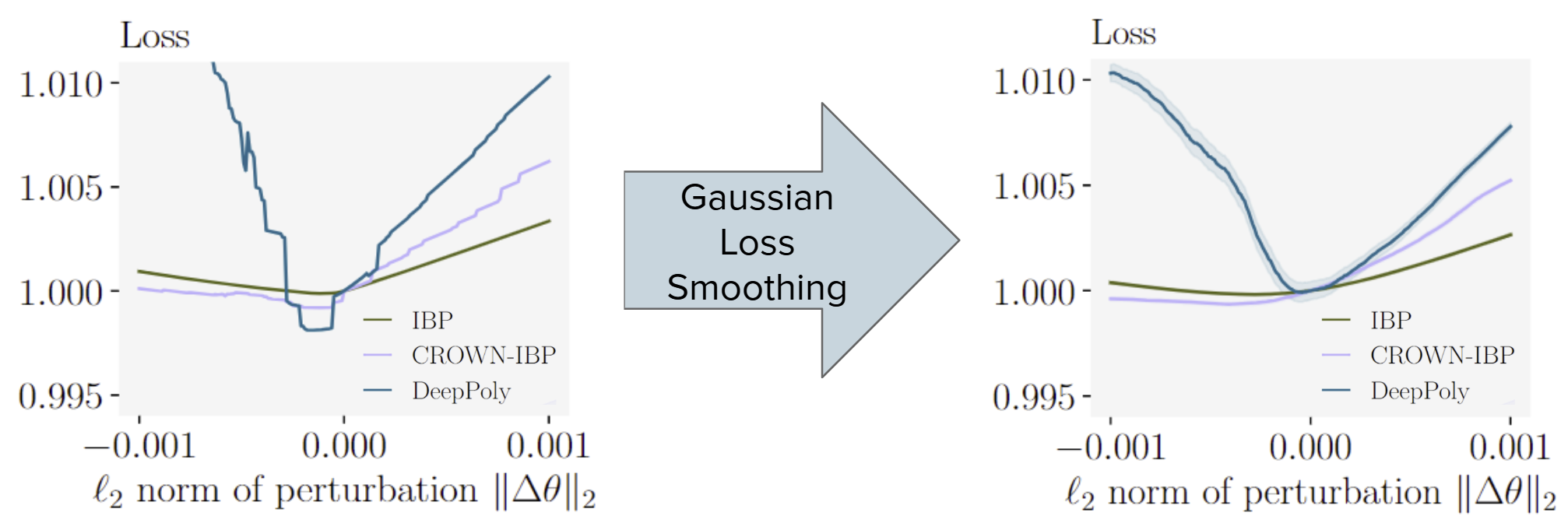
Training neural networks with high certified accuracy against adversarial examples remains an open challenge despite significant efforts. While certification methods can effectively leverage tight convex relaxations for bound computation, in training, these methods, perhaps surprisingly, can perform worse than looser relaxations. Prior work hypothesized that this phenomenon is caused by the discontinuity, non-smoothness, and perturbation sensitivity of the loss surface induced by tighter relaxations. In this work, we theoretically show that applying Gaussian Loss Smoothing (GLS) on the loss surface can alleviate these issues. We confirm this empirically by instantiating GLS with two variants: a zeroth-order optimization algorithm, called PGPE, which allows training with non-differentiable relaxations, and a first-order optimization algorithm, called RGS, which requires gradients of the relaxation but is much more efficient than PGPE. Extensive experiments show that when combined with tight relaxations, these methods surpass state-of-the-art methods when training on the same network architecture for many settings. Our results clearly demonstrate the promise of Gaussian Loss Smoothing for training certifiably robust neural networks and pave a path towards leveraging tighter relaxations for certified training.
@article{balauca2025gaussian,
  title = {Gaussian Loss Smoothing Enables Certified Training with Tight Convex Relaxations},
  author = {Balauca, Stefan and Müller, Mark Niklas and Mao, Yuhao and Baader, Maximilian and Fischer, Marc and Vechev, Martin},
  year = {2025},
  journal = {Transactions on Machine Learning Research},
  issn = {2835-8856},
  url = {https://arxiv.org/abs/2403.07095},
}






2022
- Stefan Balauca and Andreea ArusoaieIn Computational Science – ICCS 2022, 2022
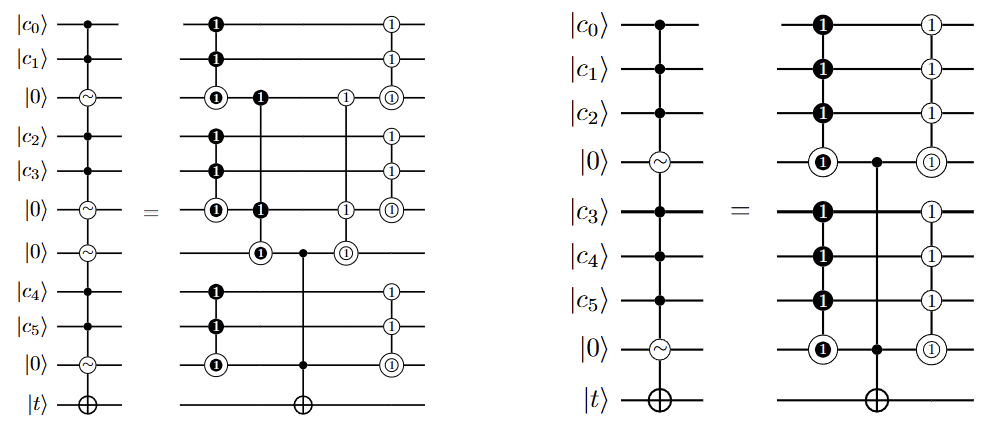
Multi Controlled Gates, with Multi Controlled Toffoli as primary example are a building block for a lot of complex quantum algorithms in the domains of discrete arithmetic, cryptography, machine learning, and image processing. However, these gates cannot be physically implemented in quantum hardware and therefore they need to be decomposed into many smaller elementary gates. In this work we analyse previously proposed circuit constructions for MCT gates and describe 6 new methods for generating MCT circuits with efficient costs, less restrictions, and improved applicability.
@inproceedings{balauca2022efficient,
  author = {Balauca, Stefan and Arusoaie, Andreea},
  title = {Efficient Constructions for Simulating Multi Controlled Quantum Gates},
  booktitle = {Computational Science -- ICCS 2022},
  year = {2022},
  publisher = {Springer International Publishing},
  pages = {179--194},
  isbn = {978-3-031-08760-8},
  url = {https://doi.org/10.1007/978-3-031-08760-8_16},
  doi = {10.1007/978-3-031-08760-8_16},
}
2019
- CYSCStefan Balauca, Leontin Pădurariu, and Liliana MitoseriuOral presentation at the 13th Conference for Young Scientists in Ceramics, 2019
@misc{balauca2019ceramic,
  title = {Finite Difference Method for Modeling the Dielectric Properties of Ceramic Composites},
  author = {Balauca, Stefan and Pădurariu, Leontin and Mitoseriu, Liliana},
  year = {2019},
  howpublished = {Oral presentation at the 13th Conference for Young Scientists in Ceramics},
}